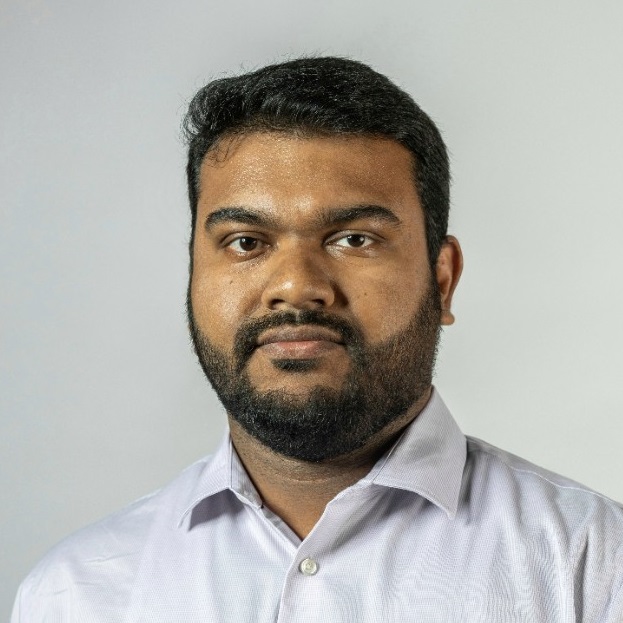
Secure AI from perception to action
Shaikh Akib Shahriyar
Ph.D. Candidate in Computing and Information Sciences
Rochester Institute of Technology (RIT), Rochester, New York
Graduate Research Assistant, ESL Global Cybersecurity Institute
Advisor: Matthew Wright
My research studies the security of AI systems that perceive and act, from deepfake detectors that analyze multimodal media to agentic AI systems that use tools, retain memory, and act on users’ behalf. I combine adversarial machine learning with systems-oriented, cost-aware evaluation to examine how attackers manipulate models, tools, memory, and multimodal inputs under realistic constraints. My goal is to develop practical evaluations and defenses that preserve legitimate functionality while keeping AI-driven decisions and actions reliable, authorized, and consistent with user intent.
I am seeking tenure-track faculty positions beginning Fall 2027.
Biography
I am a Ph.D. candidate in Computing and Information Sciences at Rochester Institute of Technology, advised by Dr. Matthew Wright, and a graduate research assistant in RIT’s ESL Global Cybersecurity Institute. My research connects adversarial machine learning and synthetic-media forensics with the security of tool-using and multi-agent AI systems. Before RIT, I taught at North Western University and KUET, where I became an Assistant Professor in 2021. I earned my B.Sc. and M.Sc. in Computer Science and Engineering from KUET.
Education
- Ph.D., Computing and Information Sciences, RIT — in progress
Advisor: Dr. Matthew Wright - M.Sc. Eng., Computer Science and Engineering, KUET — 2019
- B.Sc. Eng., Computer Science and Engineering, KUET — 2017
Academic Appointments
-
Graduate Research Assistant
ESL Global Cybersecurity Institute, Rochester Institute of Technology
–Present
-
Adjunct Faculty
Rochester Institute of Technology
–
-
Assistant Professor
Department of Computer Science and Engineering, Khulna University of Engineering & Technology (KUET)
–
-
Lecturer
Department of Computer Science and Engineering, Khulna University of Engineering & Technology (KUET)
–
-
Lecturer
North Western University, Khulna
–
Research
Current work
Practical Robustness Frontier. How much access does an attacker need to evade a deepfake detector? With collaborators, I evaluate twelve detectors from four architectural families across attacker-access levels, from zero-query transfer to adaptive white-box attacks. Working paper
Executable task contracts. When an evaluation edits a tool-using agent’s environment, is it still the user’s original task? Executable contracts make this task-relative validity checkable before the agent’s behavior is observed. Preprint
I also contribute research to usable media-forensics tools for journalists and analysts: VARUNA, supported by NSF, and DeFake, supported by NSF and the Knight Foundation.
Research agenda
My group will pursue four connected directions.
- Cost-aware multimodal robustness. Develop practical methods for evaluating the robustness of AI systems that analyze audio, video, text, and provenance signals. Building on my Practical Robustness Frontier—a framework that compares attacks by the access, queries, feedback, and semantic changes they require—I will study when combining multiple forms of evidence actually makes evasion harder and use those findings to design defenses against adaptive attackers.
- Task-preserving attacks and secure agent learning. Using executable task contracts to generate attacks that preserve the authorized task and to train agents against them, and studying how learned policies complement runtime checks without sacrificing legitimate task completion.
- Secure multi-agent orchestration. Studying how authorization and evidence propagate when agents delegate and collaborate, through scoped delegation and provenance-aware aggregation, since several agents repeating one poisoned source do not provide independent evidence.
- Persistent-memory security and personalized agents. Tracing how malicious content survives memory writing, summarization, and retrieval, and developing revocation, quarantine, and repair mechanisms. Longer term: consented personalized agents whose fidelity and permissions can be evaluated.
Publications
Full list on Google Scholar and in my CV.
Selected peer-reviewed research
-
PadNet: Defending Neural Networks Against Adversarial Examples
JournalACM Transactions on Privacy and Security, 29(2), Article 17, 2026.
DOI: PadNet: Defending Neural Networks Against Adversarial Examples PDF: PadNet: Defending Neural Networks Against Adversarial Examples
-
Discrete Optimal Transport is a Strong Audio Adversarial Attack
To appearIEEE/IAPR International Joint Conference on Biometrics (IJCB), 2026.
arXiv: Discrete Optimal Transport is a Strong Audio Adversarial Attack PDF: Discrete Optimal Transport is a Strong Audio Adversarial Attack
-
IVORY: Adversarial Purification of Obfuscated Faces to Extract Soft-Biometrics using Diffusion Transformers
ConferenceIEEE International Conference on Automatic Face and Gesture Recognition (FG), 2025.
-
Evaluating Robustness of Sequence-based Deepfake Detector Models by Adversarial Perturbation
WorkshopWorkshop on Security Implications of Deepfakes and Cheapfakes (WDC), co-located with ACM AsiaCCS, pp. 13–18, 2022.
DOI: Evaluating Robustness of Sequence-based Deepfake Detector Models by Adversarial Perturbation
Preprints & working papers
-
What Counts as the Same Task? Executable Contracts for Robustness Evaluation of Tool-Using Agents
PreprintarXiv preprint, 2026.
arXiv: What Counts as the Same Task? Executable Contracts for Robustness Evaluation of Tool-Using Agents PDF: What Counts as the Same Task? Executable Contracts for Robustness Evaluation of Tool-Using Agents
-
SoK: The Practical Robustness Frontier: Cost-Aware Vulnerability Analysis for Deepfake Detectors
Working paperWorking manuscript, 2026.
Earlier peer-reviewed publications (11)
-
A Highly Accurate Dysphonia Detection System Using Linear Discriminant Analysis
Computer Systems Science and Engineering, 2023.
DOI: A Highly Accurate Dysphonia Detection System Using Linear Discriminant Analysis
-
DNA Cryptography-Based Speech Security System
In Proceedings of the International e-Conference on Intelligent Systems and Signal Processing, Springer, pp. 573–582, 2021.
-
DOC-BLOCK: A Blockchain Based Authentication System for Digital Documents
International Conference on Intelligent Communication Technologies and Virtual Mobile Networks (ICICV), IEEE, 2021.
Paper: DOC-BLOCK: A Blockchain Based Authentication System for Digital Documents
-
Discrete Spider Monkey Optimization for Travelling Salesman Problem
Applied Soft Computing, 86, 105887, 2020.
DOI: Discrete Spider Monkey Optimization for Travelling Salesman Problem
-
A Novel Approach for E-mail Classification Using FastText
IEEE Region 10 Symposium (TENSYMP), 2020.
DOI: A Novel Approach for E-mail Classification Using FastText
-
Bangla Numeral Recognition from Speech Signal Using Convolutional Neural Network
International Conference on Bangla Speech and Language Processing (ICBSLP), IEEE, 2019.
-
Spider Monkey Optimization to Solve Traveling Salesman Problem
International Conference on Electrical, Computer and Communication Engineering (ECCE), IEEE, 2019.
DOI: Spider Monkey Optimization to Solve Traveling Salesman Problem
-
Speech Enhancement Using Convolutional Denoising Autoencoder
International Conference on Electrical, Computer and Communication Engineering (ECCE), IEEE, 2019.
DOI: Speech Enhancement Using Convolutional Denoising Autoencoder
-
An Approach for Multi Label Image Classification Using Single Label Convolutional Neural Network
International Conference of Computer and Information Technology (ICCIT), IEEE, 2018.
-
An Efficient Error Correction Approach by Using Successive Parity Generation
International Conference on Electrical Engineering and Information & Communication Technology (iCEEiCT), IEEE, 2018.
Paper: An Efficient Error Correction Approach by Using Successive Parity Generation
-
A Novel Encryption Model for Text Messages Using Delayed Chaotic Neural Network and DNA Cryptography
International Conference of Computer and Information Technology (ICCIT), IEEE, 2017.
Posters (2)
-
How Many Queries Does It Take to Break a Deepfake Detector? Preliminary Findings from a Cost-Aware Robustness Audit
Poster35th USENIX Security Symposium, 2026.
-
DiffTranPure: Diffusion Transformer-based Adversarial Purification to Extract Face and Facial Soft-Biometric Features from Obfuscated Images
Poster33rd USENIX Security Symposium, 2024.
Teaching & Mentoring
My teaching moves from clear explanations and guided experiments to projects that develop independent judgment. I use active discussion, reproducible assignments, peer review, and explicit expectations to help students test assumptions and defend their conclusions. I have taught undergraduate and graduate courses in cybersecurity, machine learning, networking, and core computer science in Bangladesh and the United States.
Teaching experience
-
Rochester Institute of Technology
- CSEC 720: Deep Learning Security (graduate), Instructor. Spring 2025; 25 M.S. and junior Ph.D. students. Designed lectures, reproducible laboratories, assessments, and research projects in adversarial ML, privacy, and robust learning.
- CSEC 140: Introduction to Cybersecurity (undergraduate), Instructor. Fall 2022, Fall 2026; about 30 students. Threats, risk, cryptography, systems, networking, privacy, and secure computing.
-
Khulna University of Engineering & Technology (KUET)
- Machine Learning, Computer Security, Computer Networks, Mobile Computing, Software Engineering, and Algorithm Analysis and Design; about 120 students per course across multiple sections.
-
North Western University, Khulna
- Artificial Intelligence, Neural Networks and Fuzzy Systems, Software Engineering, Computer Networks, and Algorithm Analysis and Design; about 40 students per course.
-
Government Teachers’ Training Institute, Khulna
- Machine learning and computer networks for cohorts of about 20 K–12 teachers.
Mentoring
At RIT, I have mentored 24 student researchers: five Ph.D. students and nineteen undergraduate and master’s students. At KUET, I mentored more than 65 students on research and capstone projects and coauthored seven student-led peer-reviewed publications. I treat mentoring as a gradual transfer of responsibility, from literature and small prototypes to experiment design and project leadership.
As Vice President of RIT’s Doctoral Student Association (2022–2025), I organized professional-development and career programming.
Future teaching
I am prepared to teach security and privacy, machine learning and computer vision, networking, algorithms, software engineering, and mobile computing. Proposed graduate seminars: Secure Agentic AI and Synthetic Media Forensics.
Service
Program committee for AAMAS 2027 and IEEE FG 2026 and 2027; reviewer for CVPR 2026. A full list of service appears in my CV.
Contact
- Email as8751@rit.edu
- Affiliation ESL Global Cybersecurity Institute, Rochester Institute of Technology, Rochester, NY
- Profiles Google Scholar · LinkedIn · GitHub
- Documents CV · Research Statement · Teaching Statement (PDF)